

A long walk can make your legs feel tired and heavy, especially if it’s not something you do all the time. This leg fatigue is perfectly normal and nothing to be concerned about. There is a type of leg heaviness, though, that can come on suddenly without having endured the exertion of a long walk. Some people describe their legs as weighted down, weak, or stiff.
If your legs feel heavy and you can’t explain it, it’s understandable to have some questions. What’s causing it? Should I be concerned? How do I know if I need medical attention?
There are many possible reasons for your legs to feel heavy. It can be as simple as muscle fatigue and reduced physical conditioning. It can also be a symptom of circulation problems or conditions affecting the nerves in the lower back. The timing and type of symptoms, whether both legs are affected, and what behavior makes the symptoms improve can all point to helpful clues about the possible underlying cause.
What Does It Mean When Your Legs Feel Heavy?
First, it’s important to understand what leg heaviness really means. What someone says their legs feel heavy, it usually means they are experiencing one or more of the following things:
- A weighted-down or dragging sensation.
- A sense of fatigue that comes on sooner than expected.
- Stiffness or trouble maintaining a normal walking pace.
- An unexplainable sense of weakness without a measurable loss of strength.
A sensation of weakness and actual muscle weakness are not always the same thing. True weakness that contributes to difficulty lifting your foot or pushing off while walking may indicate a neurological or muscular problem, but there are many other conditions and situations that can cause similar sensations.
7 Possible Reasons Your Legs Feel Heavy When Walking
The human body is a complex network of interacting systems, and there are many possible explanations for unusual symptoms or sensations. Leg heaviness is no exception. With that said, some of the causes of leg heaviness can include:
- Muscle fatigue or physical deconditioning
This is one of the more obvious and more common causes of leg heaviness. Muscles become less efficient at sustaining activity when they aren’t challenged regularly. Becoming active after a long period of inactivity, or walking farther or faster than usual, can fatigue your muscles and lead to a feeling of heaviness. The muscle weakness in this case can be in your hips, thighs, or calves. If fatigue is the cause of your symptoms, it will likely be something that affects both legs and occurs following a change or increase in activity. Age-related changes in muscle mass can also contribute, which is why it’s so important to stay active as we age.
- Lumbar spinal stenosis
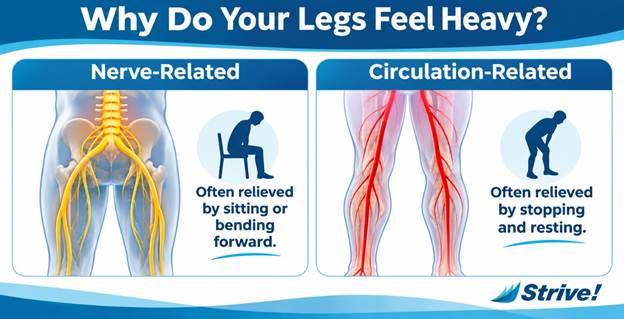
This potential cause of leg weakness occurs when spaces around the nerves in the back become narrowed. Symptoms associated with spinal stenosis can include heavy or weak-feeling legs during walking, often accompanied by numbness, tingling, or discomfort in the legs or buttocks. Symptoms may improve while sitting or bending forward. Not all cases of spinal stenosis will produce symptoms or require medical treatment, and if medical treatment is needed, in most cases symptoms can be effectively managed with conservative treatments like physical therapy1.
- Peripheral artery disease (PAD)
Peripheral artery disease (PAD) involves narrowing of arteries that supply blood to the legs, most commonly due to atherosclerosis.If this is the cause of your symptoms, you may feel heaviness or aching after a predictable amount of activity that improves after stopping and resting. Sometimes symptoms can include a foot that feels colder than the other and sores or wounds that appear on your toes, feet, or legs and heal slowly or not at all2.
- Chronic venous insufficiency
Weakened vein valves can make it difficult for blood to return efficiently from the legs toward the heart. Along with heavy or aching legs, symptoms may include swelling around the ankles or, in some cases, visible varicose veins or discolored skin. Symptoms may worsen after prolonged standing and may improve with leg elevation. The most common cause of chronic venous insufficiency is deep vein thrombosis (DVT)3.
- Nerve irritation or peripheral neuropathy
Nerves are your body’s information network, responsible for communication between the brain, spinal cord, and muscles. When these signals are disrupted, walking may feel less natural or more difficult. A sensation of leg heaviness caused by nerve problems will often be accompanied by tingling, numbness, or burning sensations. - Joint stiffness or arthritis
Reduced joint mobility associated with arthritis can make movement more physically demanding and may contribute to a sensation of leg heaviness. This can be associated with arthritis in the hip, knee, or ankle. If your symptoms are caused by joint stiffness or arthritis, you may notice they appear after resting or when you first start to walk. - Other health conditions and medication effects
As mentioned above, there are many conditions that can contribute to your legs feeling heavy. These symptoms can be associated with anemia, heart conditions, electrolyte abnormalities, and side effects of certain medications. The best way to know for sure what is causing your legs to feel heavy is to get a medical evaluation.
This list is certainly not exhaustive and should not be used as a tool for self-diagnosis. While heavy legs are not always a serious concern and may not always require medical attention, persistent or unexplainable leg heaviness that interferes with your daily life is definitely worth looking into.
What Can You Do If Your Legs Feel Heavy When Walking?
If you experience leg heaviness while walking, the first thing you can do is pay attention to patterns. This may help you get a better understanding of what’s happening and can also help you give your medical provider important information if you go for an evaluation or treatment. Pay attention to when the symptoms began, whether the symptoms affect one leg or both, and whether standing still, sitting, or leaning helps. Is the heaviness accompanied by numbness, pain, or swelling? Are symptoms getting more frequent?
If you feel like your symptoms are simply due to fatigue and no cause for medical care, you may find that just staying active and getting more exercise can help to reduce or eliminate your leg heaviness. Regular activity and progressive conditioning within appropriate limits can improve muscular endurance and make fatigue less likely.
It’s also a good idea to address any underlying health concerns. Properly managing any relevant medical conditions and following medical advice can play an important role in helping you avoid unnecessary stress on your body and causing additional symptoms. Of course, if you suspect circulation or neurological problems, get an appropriate medical evaluation.
Of course, symptoms that are persistent, recur regularly without a clear cause, or symptoms that interfere with your ability to perform basic daily tasks should always be considered a reason to get a proper evaluation. Contact your primary care provider or a local physical therapist to schedule an evaluation. Don’t let heavy legs slow you down.
At Strive! Physical Therapy Centers, our skilled and compassionate therapists have been serving the Ocala area for more than 40 years! With clinics located conveniently around Ocala and Williston, the help you need is never far away. Call us at 352.351.8883 or email us today to schedule a consultation.
Sources
- “Guide | Physical Therapy Guide to Spinal Stenosis.” Choose PT, 26 Aug. 2021, www.choosept.com/guide/physical-therapy-guide-spinal-stenosis. Accessed 3 Nov. 2026.
- National Heart, Lung, and Blood Institute. “Peripheral Artery Disease – Symptoms | NHLBI, NIH.” Www.Nhlbi.Nih.Gov, 24 Mar. 2022, www.nhlbi.nih.gov/health/peripheral-artery-disease/symptoms. Accessed 3 Nov. 2026.
- Cleveland Clinic. “Chronic Venous Insufficiency (CVI).” Cleveland Clinic, 17 July 2022, my.clevelandclinic.org/health/diseases/16872-chronic-venous-insufficiency-cvi. Accessed 3 Nov. 2026.